
IBS Symptom Tracking: From Subjective to Objective Data
Why symptom journals miss patterns, what the validated IBS measures actually achieve, and how to combine subjective and objective tracking without adding burden.

The symptom journal deserves more credit than it usually gets. For decades it was the only instrument patients with IBS had, and the discipline it takes to keep one is real. If you have filled notebooks with what you ate and how you felt, you have done serious work.
You also know something no device can measure: what your symptoms feel like, what they cost you, and which ones actually matter to your life. That is not soft data. In IBS, where treatment targets quality of life as much as stool form, it is central. Patients with IBS score worse than the general population across multiple health status domains, with impairment comparable to or exceeding several chronic organic diseases (Gralnek et al., Gastroenterology, 2000).
The argument in this article is not that subjective tracking should be replaced. It is that it should be supplemented, because human memory was never designed for the job we have been asking it to do.
The Problem Is the Method, Not Your Discipline
Retrospective symptom reporting is affected by memory and by current mood. Psychological state measurably influences how gastrointestinal symptoms are perceived and reported in IBS (Enck et al., Nature Reviews Disease Primers, 2016). A pain rating recorded on Friday about Monday is filtered through Friday.
The compliance evidence is even less flattering. In a study of 80 patients issued paper diaries fitted with a hidden photosensor that logged every time the binder was opened, only 11 percent made entries three times daily as instructed, while 90 percent reported that they had. Back-filling several days at once shortly before a visit was common (Stone et al., BMJ, 2002).
This is not a moral failing. It is what happens when you ask a person managing a chronic condition to also be a data logger. Most people stop. The people who do not stop leave gaps. Both outcomes weaken the pattern you were trying to find.
Momentary methods do better. Experience sampling, which prompts patients in real time rather than asking them to recall, has been used successfully in IBS to establish that poorer than usual subjective sleep quality predicts next-day abdominal pain and lower gastrointestinal symptoms (Topan et al., American Journal of Gastroenterology, 2024). The lesson is not that patients are unreliable. It is that timing of capture is a design variable.
What Objective Measurement Adds
Objective monitoring contributes something specific: a record that does not depend on you remembering. It is continuous rather than sampled, it does not shift with mood, and it captures the periods you would not have thought to write down.
That is genuinely valuable in a condition where symptoms are delayed, variable, and influenced by several things at once. It is also, importantly, not a diagnosis. Objective pattern data describes what is happening over time. Determining what condition is producing it remains clinical work, and IBS remains a diagnosis of exclusion made against the Rome IV criteria (Lacy et al., Gastroenterology, 2016; Lacy et al., American Journal of Gastroenterology, 2021).
What Gets Measured, and How Well
The useful question is not "subjective versus objective" in the abstract. It is what each instrument has actually been validated to do. Every figure in the table below belongs to the named instrument, not to any consumer monitoring product.
| Instrument | What it captures | Validated performance | Source |
|---|---|---|---|
| Paper symptom or food diary | Self-reported symptoms and intake | 11% of participants made entries as instructed; 90% reported that they had | Stone et al., 2002 |
| Experience sampling (momentary capture) | Real-time symptom and sleep ratings | Detected a unidirectional next-day relationship between poor subjective sleep and abdominal pain in IBS | Topan et al., 2024 |
| IBS Severity Scoring System | Pain, distension, bowel dysfunction, wellbeing | Validated in 141 patients and 40 controls; a 50-point change is treated as clinically meaningful | Francis et al., 1997 |
| Bristol Stool Form Scale | Stool form as a proxy for transit | Correlates with whole-gut transit at r = -0.61; a value below 3 predicts delayed whole-gut transit with 85% sensitivity and 82% specificity | Lewis and Heaton, 1997; Saad et al., 2010 |
| Fecal calprotectin | Intestinal inflammation | Pooled sensitivity 93%, specificity 94% for IBD in adults | van Rheenen et al., 2010 |
| Hydrogen and methane breath testing | Carbohydrate maldigestion, SIBO, methane status | Consensus thresholds: hydrogen rise of at least 20 ppm by 90 minutes; methane at least 10 ppm | Rezaie et al., 2017 |
| Wearable physiological monitoring (IBD, research) | Heart rate variability, heart rate, steps, oxygenation | Signals altered up to 7 weeks before flares in 309 participants; research finding, not a cleared device | Hirten et al., 2025 |
Two Kinds of Data, One Picture
- Subjective data tells you how you feel, how severe it is to you, how it affects your work and relationships, and what you want treatment to change. Nothing else can supply this.
- Objective data tells you what happened and when, without gaps, and independent of recall.
- Together they let you and your clinician connect a physiological pattern to a lived consequence, which is the connection treatment decisions actually rest on.
How the Transition Works in Practice
Moving from journaling to a combined approach works best gradually.
- Weeks one to four, run both. Keep your existing journal and add passive monitoring alongside it. Compare. You are checking whether the objective record matches your lived experience.
- Weeks five to eight, look for gaps. Are there patterns in the continuous data that never made it into your notes? Are there suspicions in your notes that the data does not support?
- Weeks nine to twelve, reduce the burden. Let the passive system carry the routine record. Reserve your own entries for what only you can report, which is how you feel and what it is costing you. Scoring yourself periodically with the IBS-SSS gives that a validated number (Francis et al., 1997).
- Ongoing, keep it sustainable. The best tracking system is the one still running in six months.
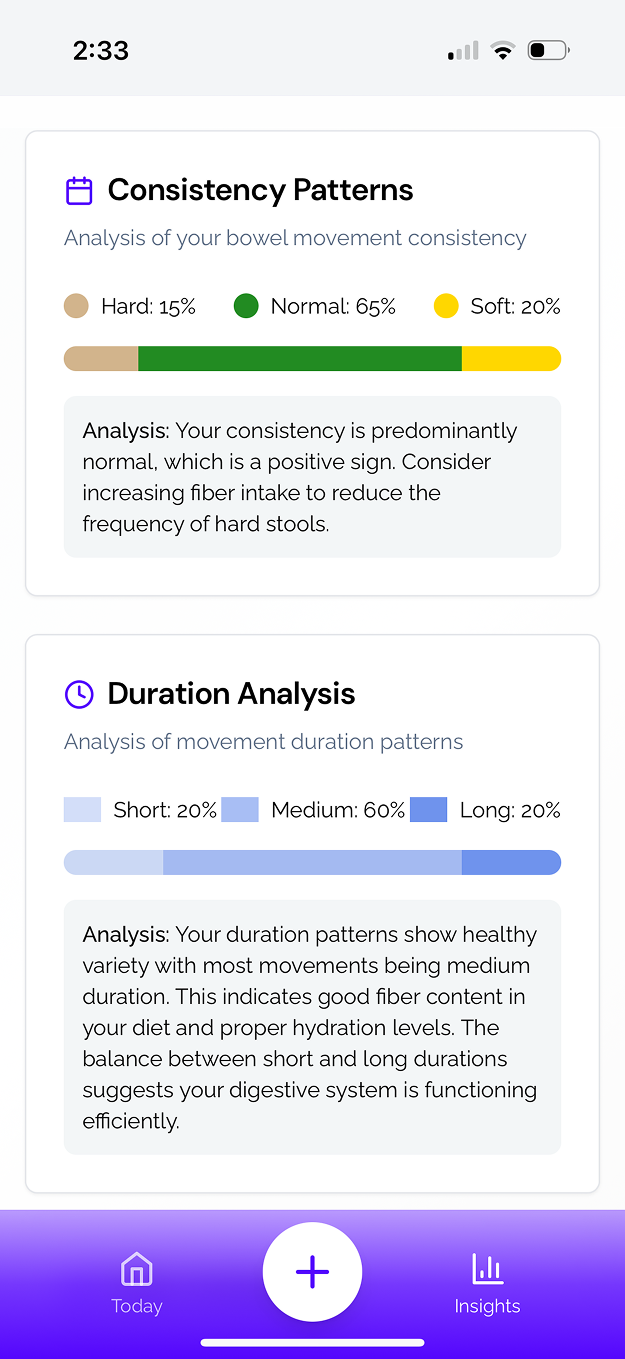
This is the role SNIFR is being designed for, and our overview of advanced digestive monitoring for IBS and gastrointestinal diseases covers how continuous data supports rather than replaces clinical assessment.
Hypothetical scenario. Consider a hypothetical case: a patient who describes his last six months as "mostly bad" arrives with three months of stool form records and IBS-SSS scores taken monthly. The scores fell by 60 points after a dietitian-supervised FODMAP reintroduction, above the 50-point threshold treated as clinically meaningful (Francis et al., Alimentary Pharmacology and Therapeutics, 1997), even though his recollection was that nothing had changed. The consultation starts from that discrepancy rather than from reconstruction. This is an illustrative example of what structured records do to a conversation, not an outcome attributed to any product.
Why Clinicians Value Structured Data
Your gastroenterologist has limited time and is trying to reconstruct months of variable symptoms from a conversation. Anything that improves the fidelity of that reconstruction improves the decision that follows.
Structured, objective records help a clinician characterise your symptom pattern more precisely, subtype IBS using predominant stool form on days with abnormal bowel movements as Rome IV specifies (Lacy et al., Gastroenterology, 2016), judge whether an intervention is actually working against a validated instrument, and notice a change in pattern that warrants further investigation. What it does not do is make the diagnosis.
A Realistic Set of Expectations
- Objective monitoring reduces recall bias. It does not eliminate uncertainty.
- It shows patterns. It does not explain mechanisms on its own.
- It supports clinical decisions. It does not make them.
- It does not diagnose IBS or any other condition, and it does not replace colonoscopy, endoscopy, breath testing, stool studies, or blood work.
- For some people, frequent self-monitoring increases preoccupation with symptoms. If that is you, say so, and adjust.
Red Flag Symptoms That Need Prompt Medical Attention
Better tracking is not the right response to these. The BSG lists family history of colorectal cancer or inflammatory bowel disease, unexplained weight loss, rectal bleeding not due to haemorrhoids, nocturnal diarrhoea and unexplained iron deficiency anaemia as alarm features requiring urgent colonoscopy or radiological evaluation of the colon (Vasant et al., Gut, 2021). Prompt medical evaluation is the right response to:
- Rectal bleeding, or black, tarry stools
- Unintentional weight loss
- Symptoms that wake you from sleep
- Unexplained anemia or iron deficiency
- Fever, persistent vomiting, or severe abdominal pain
- A family history of colorectal cancer, inflammatory bowel disease, or celiac disease
- New or changing bowel symptoms after age 50
Building on What You Already Did
The value of the symptom journal was never the notebook. It was the habit of paying attention to your body and taking what it tells you seriously. That habit is the foundation everything else is built on.
What objective measurement adds is the part memory could never supply: an unbroken record you did not have to maintain. Keep the attention. Hand off the bookkeeping.
Frequently Asked Questions
Why is my IBS symptom journal not showing clear patterns?
Usually gaps and recall drift rather than anything you did wrong. In one controlled study, only 11 percent of participants filled paper diaries as instructed while 90 percent said they had, and back-filling several days at once was common. Symptom perception and reporting also shift with psychological state, so the record blurs.
What is objective IBS symptom tracking?
Recording physiological information continuously rather than relying on memory. The advantage is that it does not depend on you remembering, does not shift with mood, and covers periods you would not have thought to log. It describes patterns, but it does not diagnose any condition and does not replace clinical testing.
Should I stop keeping a symptom journal if I use objective monitoring?
No. Subjective reporting captures how symptoms feel and what they cost you, which matters in IBS because quality of life impairment is comparable to several chronic organic diseases. Let passive monitoring carry the routine record and reserve your own entries for lived experience, ideally with a validated score such as the IBS-SSS.
How does objective data help my gastroenterologist?
It improves the fidelity of what your clinician is working from. Structured records help characterise your pattern, subtype IBS by predominant stool form as Rome IV specifies, judge whether an intervention is working against a validated instrument, and flag changes worth investigating. It informs clinical judgment rather than replacing it.
Can symptom tracking make IBS anxiety worse?
For some people, yes. Frequent self-monitoring can increase preoccupation with symptoms, particularly if anxiety is already prominent. Many patients find the opposite, because uncertainty drops. If tracking is raising your distress, tell your clinician and adjust the approach rather than pushing through.
How long before objective tracking shows something useful?
Most people need at least a few weeks of consistent data before patterns become interpretable, since a baseline has to exist before a departure from it means anything. Running your existing journal alongside passive monitoring for the first month helps you check that the record matches your experience.
Which IBS measures are actually validated?
The IBS Severity Scoring System was validated in 141 patients and 40 controls and treats a 50-point change as clinically meaningful. The Bristol Stool Form Scale correlates with whole-gut transit at r = -0.61, and a value below 3 predicts delayed transit with 85 percent sensitivity and 82 percent specificity. Both are free to use.
References
- Gralnek IM, Hays RD, Kilbourne A, Naliboff B, Mayer EA. The impact of irritable bowel syndrome on health-related quality of life. Gastroenterology. 2000;119(3):654-660. doi:10.1053/gast.2000.16484
- Stone AA, Shiffman S, Schwartz JE, Broderick JE, Hufford MR. Patient non-compliance with paper diaries. BMJ. 2002;324(7347):1193-1194. doi:10.1136/bmj.324.7347.1193
- Topan R, Vork L, Fitzke H, et al. Poor Subjective Sleep Quality Predicts Symptoms in Irritable Bowel Syndrome Using the Experience Sampling Method. American Journal of Gastroenterology. 2024;119(1):155-164. doi:10.14309/ajg.0000000000002510
- Lacy BE, Mearin F, Chang L, Chey WD, Lembo AJ, Simren M, Spiller R. Bowel Disorders. Gastroenterology. 2016;150(6):1393-1407.e5. doi:10.1053/j.gastro.2016.02.031
- Lacy BE, Pimentel M, Brenner DM, Chey WD, Keefer LA, Long MD, Moshiree B. ACG Clinical Guideline: Management of Irritable Bowel Syndrome. American Journal of Gastroenterology. 2021;116(1):17-44. doi:10.14309/ajg.0000000000001036
- Francis CY, Morris J, Whorwell PJ. The irritable bowel severity scoring system: a simple method of monitoring irritable bowel syndrome and its progress. Alimentary Pharmacology and Therapeutics. 1997;11(2):395-402. doi:10.1046/j.1365-2036.1997.142318000.x
- Lewis SJ, Heaton KW. Stool Form Scale as a Useful Guide to Intestinal Transit Time. Scandinavian Journal of Gastroenterology. 1997;32(9):920-924. doi:10.3109/00365529709011203
- Saad RJ, Rao SSC, Koch KL, et al. Do Stool Form and Frequency Correlate With Whole-Gut and Colonic Transit? Results From a Multicenter Study in Constipated Individuals and Healthy Controls. American Journal of Gastroenterology. 2010;105(2):403-411. doi:10.1038/ajg.2009.612
- van Rheenen PF, Van de Vijver E, Fidler V. Faecal calprotectin for screening of patients with suspected inflammatory bowel disease: diagnostic meta-analysis. BMJ. 2010;341:c3369. doi:10.1136/bmj.c3369
- Rezaie A, Buresi M, Lembo A, et al. Hydrogen and Methane-Based Breath Testing in Gastrointestinal Disorders: The North American Consensus. American Journal of Gastroenterology. 2017;112(5):775-784. doi:10.1038/ajg.2017.46
- Hirten RP, Danieletto M, Sanchez-Mayor M, et al. Physiological Data Collected From Wearable Devices Identify and Predict Inflammatory Bowel Disease Flares. Gastroenterology. 2025;168(5):939-951.e5. doi:10.1053/j.gastro.2024.12.024
- Vasant DH, Paine PA, Black CJ, et al. British Society of Gastroenterology guidelines on the management of irritable bowel syndrome. Gut. 2021;70(7):1214-1240. doi:10.1136/gutjnl-2021-324598
- Canavan C, West J, Card T. The epidemiology of irritable bowel syndrome. Clinical Epidemiology. 2014;6:71-80. doi:10.2147/CLEP.S40245
- Ford AC, Moayyedi P, Chey WD, et al. American College of Gastroenterology Monograph on Management of Irritable Bowel Syndrome. American Journal of Gastroenterology. 2018;113(Suppl 2):1-18. doi:10.1038/s41395-018-0084-x
- Chey WD, Kurlander J, Eswaran S. Irritable Bowel Syndrome: A Clinical Review. JAMA. 2015;313(9):949-958. doi:10.1001/jama.2015.0954
- Drossman DA, Hasler WL. Rome IV. Functional GI Disorders: Disorders of Gut-Brain Interaction. Gastroenterology. 2016;150(6):1257-1261. doi:10.1053/j.gastro.2016.03.035
SNIFR is designed to provide insights about gut health patterns, not to diagnose or treat medical conditions. Individual results may vary as gut health is influenced by numerous factors including diet, stress, sleep, and genetics. SNIFR is currently in development, and features described may evolve before commercial release.
Other Posts



Be first to try SNIFR. Beta coming soon.
Join our waitlist to get notified when the app launches. Start understanding your gut health sooner.