
Beyond IBS: Digestive Monitoring That Supports GI Care
What the established GI tests actually achieve, from calprotectin to SeHCAT, and where at-home digestive monitoring fits. It does not detect or diagnose any condition.

Most conversations about at-home digestive monitoring start and end with irritable bowel syndrome. That is understandable, since IBS is common and frustrating enough to drive a lot of demand. But patients living with inflammatory bowel disease, celiac disease, chronic pancreatitis, or persistent functional symptoms ask the same reasonable question: does any of this help me?
The honest clinical answer is: potentially, and in a specific role. Monitoring is not a shortcut around diagnosis. It is a way of adding continuous information to a care plan that a clinician is already directing.
This article sets out that role carefully, because the distinction between supporting a care plan and substituting for one is where patients get hurt. It also sets out what the established diagnostic tests in this space actually achieve, because those numbers are the benchmark any new technology has to be measured against.
First, the Boundary Line
Advanced digestive monitoring, including VOC analysis of stool gas of the kind SNIFR is developing, does not detect, screen for, or diagnose disease. It does not identify inflammatory bowel disease, celiac disease, small intestinal bacterial overgrowth, infection, or colorectal cancer. It does not substitute for colonoscopy, endoscopy, breath testing, stool studies such as fecal calprotectin, imaging, or biopsy.
I want that stated before anything else, because the research literature in this field is genuinely exciting and it is very easy to read a promising study and hear a promise. Those are different things. Every performance figure in this article belongs to an established clinical test, not to VOC analysis and not to SNIFR.
What the Established Tests Actually Achieve
Before assessing anything new, it helps to know what the current toolkit delivers. These are the tests your gastroenterologist is choosing between.
Fecal Calprotectin
Calprotectin is a neutrophil protein that appears in stool when there is intestinal inflammation. In a diagnostic meta-analysis of screening for suspected inflammatory bowel disease, pooled sensitivity was 93 percent and specificity 94 percent in adults (van Rheenen et al., BMJ, 2010). At a low cut-off of 50 micrograms per gram, sensitivity rises and specificity falls, which is exactly the trade-off you want in a rule-out test. It is a triage tool for deciding who needs endoscopy, not a diagnosis in itself.
Celiac Serology
IgA anti-tissue transglutaminase is the first-line test. A systematic review with meta-analysis reported summary sensitivity of 90.7 percent (95 percent CI 87.3 to 93.2) and specificity of 87.4 percent (95 percent CI 84.4 to 90.0) in adults (Sheppard et al., Alimentary Pharmacology and Therapeutics, 2022). Testing must be performed while the patient is still eating gluten, because both antibodies and biopsy findings normalise on a gluten-free diet (Rubio-Tapia et al., American Journal of Gastroenterology, 2023).
Fecal Elastase-1 for Pancreatic Exocrine Insufficiency
In a systematic review and meta-analysis, a cut-off of 200 micrograms per gram gave pooled sensitivity of 0.94 and specificity of 0.69, while lowering the cut-off to 100 micrograms per gram improved specificity to 0.82 at the cost of sensitivity falling to 0.88 (de la Iglesia et al., United European Gastroenterology Journal, 2025). Conventionally, values above 200 are normal, 100 to 200 suggest moderate insufficiency, and below 100 are consistent with pancreatic exocrine insufficiency.
Bile Acid Diarrhea
This is the diagnosis most often missed in patients labelled with IBS-D. A systematic review of SeHCAT scanning in diarrhoea-predominant IBS found that among 1,073 patients across 17 studies, 32 percent had SeHCAT seven-day retention below 10 percent, 26 percent had retention below 15 percent, and 10 percent had severe malabsorption with retention below 5 percent (Wedlake et al., Alimentary Pharmacology and Therapeutics, 2009). Response to a bile acid binder followed a dose-response pattern: 96 percent of those with retention below 5 percent responded to colestyramine, 80 percent below 10 percent, and 70 percent below 15 percent.
Clostridioides difficile
No single stool test is adequate on its own. ACG guidance supports a two-step algorithm pairing a highly sensitive screen, glutamate dehydrogenase antigen or nucleic acid amplification testing, with a more specific toxin enzyme immunoassay, because toxin-negative but NAAT-positive results frequently reflect colonisation rather than active infection (Kelly et al., American Journal of Gastroenterology, 2021).
Hydrogen and Methane Breath Testing
Breath testing is a legitimate clinical method with published thresholds. Under the North American Consensus, a rise in hydrogen of at least 20 parts per million above baseline by 90 minutes during glucose or lactulose testing is considered positive for small intestinal bacterial overgrowth, and a methane level of at least 10 parts per million at any point is considered methane-positive (Rezaie et al., American Journal of Gastroenterology, 2017). The same consensus concluded that breath testing is useful for carbohydrate maldigestion and methane-associated constipation, but not for assessing oro-cecal transit.
Interpretation matters, because SIBO is common in IBS populations. A meta-analysis of 50 case-control studies covering 8,398 patients with IBS found a pooled SIBO prevalence of 38 percent (95 percent CI 32 to 44) and an odds ratio of 4.7 (95 percent CI 3.1 to 7.2) against controls, with prevalence higher when diagnosed by breath test at 40 percent than by culture at 19 percent (Shah et al., American Journal of Gastroenterology, 2020). That gap is itself a caution about test choice.
| Test | Reported performance | Threshold or reference value | Source |
|---|---|---|---|
| Fecal calprotectin (suspected IBD, adults) | Sensitivity 93%, specificity 94% | Commonly 50 micrograms per gram for rule-out | van Rheenen et al., 2010 |
| IgA anti-tissue transglutaminase (adults) | Sensitivity 90.7%, specificity 87.4% | Assay-specific; requires gluten in the diet | Sheppard et al., 2022 |
| Fecal elastase-1 | Sensitivity 0.94, specificity 0.69 | 200 micrograms per gram | de la Iglesia et al., 2025 |
| Fecal elastase-1 | Sensitivity 0.88, specificity 0.82 | 100 micrograms per gram | de la Iglesia et al., 2025 |
| SeHCAT (bile acid malabsorption in IBS-D) | 32% of patients positive; 80% respond to colestyramine at this threshold | 7-day retention below 10% | Wedlake et al., 2009 |
| Hydrogen breath test (SIBO) | Consensus criterion, not a sensitivity figure | Rise of at least 20 ppm above baseline by 90 minutes | Rezaie et al., 2017 |
| Methane breath test | Consensus criterion | At least 10 ppm at any point | Rezaie et al., 2017 |
| C. difficile two-step algorithm | Sensitive screen plus specific toxin confirmation | GDH or NAAT, then toxin EIA | Kelly et al., 2021 |
What the VOC Research Actually Shows
Volatile organic compounds are gaseous metabolic byproducts generated by gut bacteria and host cells. Because different microbial communities and different metabolic states produce different compounds, VOC profiles carry information about what is happening in the gut.
The most rigorous synthesis to date is a systematic review and meta-analysis in inflammatory bowel disease, pooling 696 IBD cases against 605 controls, which reported sensitivity of 87 percent and specificity of 83 percent with an area under the curve of 0.92; restricted to fecal VOC studies, pooled sensitivity was 87 percent and specificity 91 percent (Krishnamoorthy et al., Journal of Crohn's and Colitis, 2024). In IBS specifically, a systematic review found that 57 percent of included studies separated IBS patients from healthy controls, with areas under the curve between 0.83 and 0.99 (Zhang et al., Neurogastroenterology and Motility, 2023).
Those are group-level research findings from mostly small, single-centre studies with heterogeneous analytical platforms. They are not test characteristics you can apply to an individual patient, and there is no approved VOC-based diagnostic in routine gastroenterology practice today. Anyone claiming otherwise has outrun the evidence.
Where Continuous Monitoring May Support a Clinician-Managed Plan
Once a diagnosis exists and a treatment plan is in place, the clinical problem changes shape. It stops being "what is this?" and becomes "how is this behaving between appointments?" That is a monitoring question, and it is where continuous data has the most plausible near-term value.
Inflammatory Bowel Disease
IBD is managed with objective markers for good reason: symptoms and inflammation do not always track together. Your gastroenterologist will use tools such as fecal calprotectin, C-reactive protein, endoscopy, and imaging to assess disease activity. None of those are replaced by at-home monitoring.
What at-home pattern data may add is texture between those measurements. There is genuine research momentum here. In a prospective study of 309 participants with IBD across 36 states, physiological metrics from consumer wearables including heart rate variability, heart rate, resting heart rate, steps and oxygenation differed significantly up to seven weeks before both inflammatory and symptomatic flares (Hirten et al., Gastroenterology, 2025). That is a monitoring finding, not a cleared diagnostic, and any suspected flare still needs clinical assessment.
Celiac Disease
Celiac disease is diagnosed by serology and duodenal biopsy while the patient is still eating gluten. Starting a gluten-free diet before testing can make the diagnosis much harder to establish, which is one of the most common and most avoidable problems I see (Rubio-Tapia et al., American Journal of Gastroenterology, 2023).
After diagnosis, the work is lifelong strict gluten avoidance with dietitian support and periodic clinical follow-up. Symptom pattern tracking can help you and your care team notice when something has drifted, but confirming ongoing intestinal healing or hidden gluten exposure is a clinical assessment, not a consumer one.
Malabsorptive and Pancreatic Conditions
Pancreatic exocrine insufficiency and bile acid diarrhea both present as chronic loose stools and both are frequently mislabelled as IBS-D. They are also both treatable, with pancreatic enzyme replacement and bile acid binders respectively, which is why the diagnostic step matters so much (de la Iglesia et al., 2025; Wedlake et al., 2009). Pattern tracking may prompt the right question. Fecal elastase and SeHCAT answer it.
Functional Dyspepsia, Gastroparesis, and Chronic Constipation
These conditions share a frustrating quality: symptoms fluctuate day to day, and a single clinic visit captures one arbitrary point on that curve. Structured, sustained records of symptom timing, stool form, and meal patterns genuinely help a clinician characterise the problem. Diagnosis still rests on the appropriate testing, such as gastric emptying studies or motility assessment, ordered by your specialist.
Suspected Small Intestinal Bacterial Overgrowth
SIBO is assessed with hydrogen and methane breath testing performed under standardised conditions, interpreted by a clinician who knows the limitations of the test. At-home gas or VOC monitoring is not a SIBO test and should never be treated as one. Self-diagnosing SIBO and self-treating it with antimicrobials or restrictive diets is a genuinely bad idea.
The Monitoring Question Versus the Diagnostic Question
The clearest way I can frame this for patients is with two columns of questions.
- Diagnostic questions ask what condition is present, whether there is inflammation, whether there is a structural lesion, and whether cancer needs to be excluded. These belong to your clinician and to validated testing.
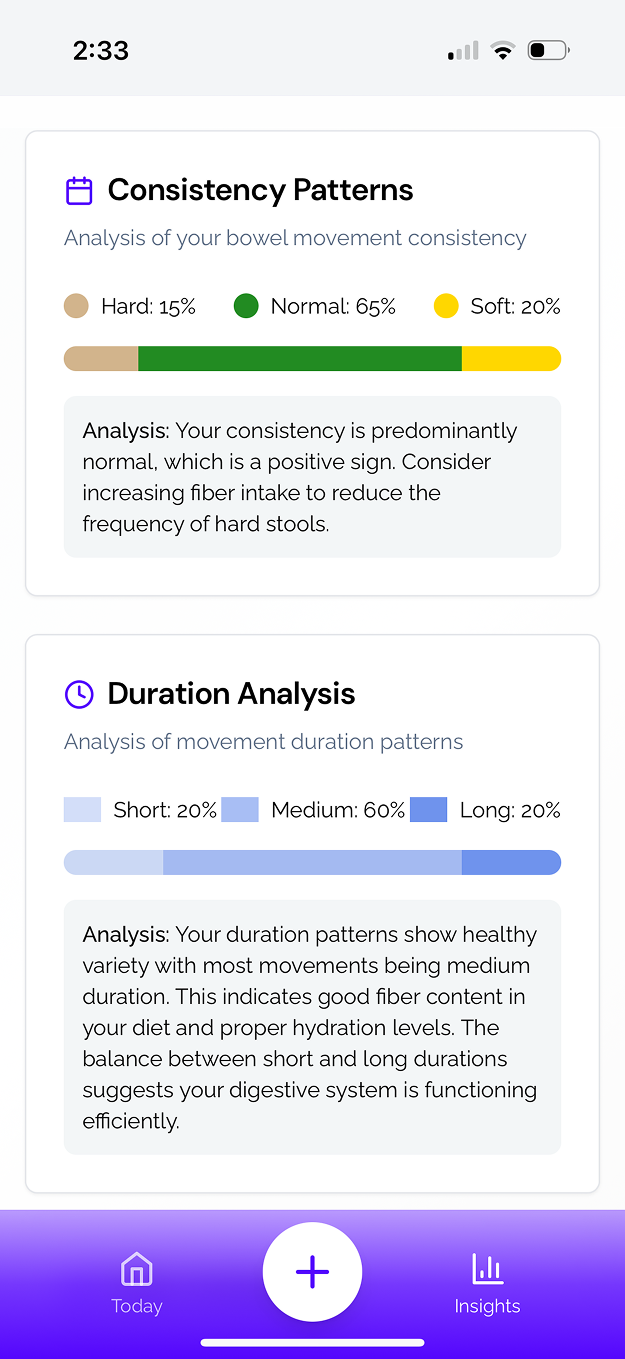
- Monitoring questions ask how your condition behaves over time, whether patterns cluster around particular foods, stress, or sleep, and whether the plan you are following appears to be helping.
Monitoring tools can contribute to the second column. They should never be used to answer the first. Our broader overview of advanced digestive monitoring across IBS and gastrointestinal diseases walks through how these two roles fit together in practice.
Hypothetical scenario. As an illustrative scenario, imagine an adult carrying an IBS-D label for six years whose stools are consistently Bristol type 6 and who has never had a bile acid assessment. Because roughly a third of patients with diarrhoea-predominant IBS have SeHCAT seven-day retention below 10 percent (Wedlake et al., Alimentary Pharmacology and Therapeutics, 2009), her gastroenterologist orders the test rather than another dietary elimination. Continuous stool-form records were what made the persistence of the pattern visible; the diagnosis came from the test, and the treatment decision came from the clinician. No monitoring product identified the condition.
Red Flag Symptoms That Need Prompt Medical Attention
Across every condition discussed here, the same warning signs override any tracking plan. The BSG guideline lists family history of colorectal cancer or inflammatory bowel disease, unexplained weight loss, rectal bleeding not due to haemorrhoids, nocturnal diarrhoea, and unexplained iron deficiency anaemia as alarm features requiring urgent colonoscopy or radiological evaluation of the colon (Vasant et al., Gut, 2021). Seek prompt medical care for:
- Rectal bleeding or black, tarry stools
- Unintentional weight loss
- Nocturnal diarrhea or pain that wakes you from sleep
- Unexplained anemia or iron deficiency
- Persistent vomiting, fever, or severe abdominal pain
- A family history of colorectal cancer, inflammatory bowel disease, or celiac disease
- New or changing bowel habits after age 50, or earlier if you have risk factors
Also please keep up with colorectal cancer screening on the schedule your clinician recommends. No monitoring technology, current or future, is a reason to defer it.
How to Use Monitoring Data Well
- Get diagnosed first, by a clinician, using validated testing.
- Treat monitoring output as pattern information, not as a result.
- Bring it to appointments rather than acting on it alone.
- Never change or stop a prescribed medication based on a monitoring reading.
- Escalate promptly if red flag symptoms appear, regardless of what any data says.
The Realistic Version of the Future
What would convince me, as a clinician, to rely on this class of technology? Large multicentre validation, clear performance characteristics of the kind quoted above for calprotectin and elastase, reproducibility across diverse populations, and integration into professional society guidance. That work is underway in research settings and it will take time.
In the meantime, the useful framing is modest and true. Continuous at-home data can make you a better-informed participant in a care plan your gastroenterologist is running. That is a real contribution. It is not a replacement for the workup, and it should never delay one.
Frequently Asked Questions
Can at-home digestive monitoring detect diseases like IBD or colon cancer?
No. At-home digestive monitoring, including VOC analysis, does not detect or diagnose inflammatory bowel disease, celiac disease, SIBO, or colorectal cancer. Diagnosis requires clinician-ordered testing such as endoscopy, biopsy, imaging, stool studies, or serology. Monitoring can describe patterns over time within a care plan your gastroenterologist is already directing.
What is the difference between IBS and IBD?
IBS is a disorder of gut-brain interaction diagnosed by symptom criteria after other causes are excluded, and it does not damage the bowel. IBD involves inflammation and tissue damage confirmed on endoscopy and biopsy. Fecal calprotectin helps separate them, with pooled sensitivity of 93 percent and specificity of 94 percent in adults with suspected IBD.
Do I still need a colonoscopy if I am monitoring my digestive health at home?
Yes. At-home monitoring does not replace colonoscopy, endoscopy, breath testing, or any part of a clinical workup, and it is not a colorectal cancer screening tool. Follow the screening schedule your clinician recommends based on your age, family history, and symptoms. Monitoring data is supplementary information, not a screening result.
Is VOC analysis of the gut a proven clinical test?
Not yet. A meta-analysis in inflammatory bowel disease pooled 696 cases against 605 controls and reported sensitivity of 87 percent and specificity of 83 percent, but the underlying studies are mostly small, single-centre and methodologically varied. There is no approved VOC-based diagnostic in routine gastroenterology practice.
Can monitoring help me manage a gastrointestinal disease I already have?
It may help with the monitoring question rather than the diagnostic one. In a study of 309 patients with IBD, wearable-derived physiological signals differed up to seven weeks before flares, which shows the research direction. Disease activity itself is still assessed with calprotectin, bloodwork, endoscopy, or imaging.
Should I start a gluten-free diet before being tested for celiac disease?
No. Celiac testing requires you to still be eating gluten, because both antibodies and biopsy findings can normalise on a gluten-free diet. IgA anti-tissue transglutaminase has reported sensitivity of about 91 percent and specificity of about 87 percent in adults, but only when performed on a gluten-containing diet. Talk to your clinician first.
What conditions are most often mistaken for IBS-D?
Bile acid diarrhea, pancreatic exocrine insufficiency, microscopic colitis, celiac disease and small intestinal bacterial overgrowth. Around 32 percent of patients with diarrhoea-predominant IBS have SeHCAT seven-day retention below 10 percent, and a meta-analysis found SIBO in 38 percent of IBS patients. These have specific treatments, which is why the workup matters.
References
- van Rheenen PF, Van de Vijver E, Fidler V. Faecal calprotectin for screening of patients with suspected inflammatory bowel disease: diagnostic meta-analysis. BMJ. 2010;341:c3369. doi:10.1136/bmj.c3369
- Sheppard AL, Elwenspoek MMC, Scott LJ, et al. Systematic review with meta-analysis: the accuracy of serological tests to support the diagnosis of coeliac disease. Alimentary Pharmacology and Therapeutics. 2022;55(5):514-527. doi:10.1111/apt.16729
- Rubio-Tapia A, Hill ID, Semrad C, et al. American College of Gastroenterology Guidelines Update: Diagnosis and Management of Celiac Disease. American Journal of Gastroenterology. 2023;118(1):59-76. doi:10.14309/ajg.0000000000002075
- de la Iglesia D, Agudo-Castillo B, Galego-Fernández M, Rama-Fernández A, Domínguez-Muñoz JE. Diagnostic Accuracy of Fecal Elastase-1 Test for Pancreatic Exocrine Insufficiency: A Systematic Review and Meta-Analysis. United European Gastroenterology Journal. 2025;13(8):1571-1582. doi:10.1002/ueg2.70061
- Wedlake L, A’Hern R, Russell D, Thomas K, Walters JRF, Andreyev HJN. Systematic review: the prevalence of idiopathic bile acid malabsorption as diagnosed by SeHCAT scanning in patients with diarrhoea-predominant irritable bowel syndrome. Alimentary Pharmacology and Therapeutics. 2009;30(7):707-717. doi:10.1111/j.1365-2036.2009.04081.x
- Kelly CR, Fischer M, Allegretti JR, et al. ACG Clinical Guidelines: Prevention, Diagnosis, and Treatment of Clostridioides difficile Infections. American Journal of Gastroenterology. 2021;116(6):1124-1147. doi:10.14309/ajg.0000000000001278
- Rezaie A, Buresi M, Lembo A, et al. Hydrogen and Methane-Based Breath Testing in Gastrointestinal Disorders: The North American Consensus. American Journal of Gastroenterology. 2017;112(5):775-784. doi:10.1038/ajg.2017.46
- Shah A, Talley NJ, Jones M, et al. Small Intestinal Bacterial Overgrowth in Irritable Bowel Syndrome: A Systematic Review and Meta-Analysis of Case-Control Studies. American Journal of Gastroenterology. 2020;115(2):190-201. doi:10.14309/ajg.0000000000000504
- Krishnamoorthy A, Chandrapalan S, Ahmed M, Arasaradnam RP. The Diagnostic Utility of Volatile Organic Compounds in Inflammatory Bowel Disease: A Systematic Review and Meta-Analysis. Journal of Crohn’s and Colitis. 2024;18(2):320-330. doi:10.1093/ecco-jcc/jjad132
- Zhang VR, Ramachandran GK, Loo EXL, Soh AYS, Yong WP, Siah KTH. Volatile organic compounds as potential biomarkers of irritable bowel syndrome: A systematic review. Neurogastroenterology & Motility. 2023;35(7):e14536. doi:10.1111/nmo.14536
- Ahmed I, Greenwood R, Costello BdL, Ratcliffe NM, Probert CS. An Investigation of Fecal Volatile Organic Metabolites in Irritable Bowel Syndrome. PLoS ONE. 2013;8(3):e58204. doi:10.1371/journal.pone.0058204
- Hirten RP, Danieletto M, Sanchez-Mayor M, et al. Physiological Data Collected From Wearable Devices Identify and Predict Inflammatory Bowel Disease Flares. Gastroenterology. 2025;168(5):939-951.e5. doi:10.1053/j.gastro.2024.12.024
- Vasant DH, Paine PA, Black CJ, et al. British Society of Gastroenterology guidelines on the management of irritable bowel syndrome. Gut. 2021;70(7):1214-1240. doi:10.1136/gutjnl-2021-324598
- Lacy BE, Pimentel M, Brenner DM, Chey WD, Keefer LA, Long MD, Moshiree B. ACG Clinical Guideline: Management of Irritable Bowel Syndrome. American Journal of Gastroenterology. 2021;116(1):17-44. doi:10.14309/ajg.0000000000001036
- Lacy BE, Mearin F, Chang L, Chey WD, Lembo AJ, Simren M, Spiller R. Bowel Disorders. Gastroenterology. 2016;150(6):1393-1407.e5. doi:10.1053/j.gastro.2016.02.031
- de Meij TG, Larbi IB, van der Schee MP, et al. Electronic nose can discriminate colorectal carcinoma and advanced adenomas by fecal volatile biomarker analysis: proof of principle study. International Journal of Cancer. 2014;134(5):1132-1138. doi:10.1002/ijc.28446
- Bosch S, Berkhout DJ, Ben Larbi I, de Meij TG, de Boer NK. Fecal volatile organic compounds for early detection of colorectal cancer: where are we now? Journal of Cancer Research and Clinical Oncology. 2019;145(1):223-234. doi:10.1007/s00432-018-2821-3
- van Gaal N, Lakenman R, Covington J, et al. Faecal volatile organic compounds analysis using field asymmetric ion mobility spectrometry: non-invasive diagnostics in gastrointestinal disease. Journal of Breath Research. 2018;12(1):016006. doi:10.1088/1752-7163/aa6f1d
- Arasaradnam RP, McFarlane M, Daulton E, et al. Non-invasive exhaled volatile organic biomarker analysis to detect inflammatory bowel disease. Digestive and Liver Disease. 2016;48(2):148-153. doi:10.1016/j.dld.2015.10.013
- Smolinska A, Tedjo DI, Blanchet L, et al. Volatile metabolites in breath strongly correlate with gut microbiome in CD patients. Analytica Chimica Acta. 2018;1025:1-11. doi:10.1016/j.aca.2018.03.046
- Berkhout DJC, Niemarkt HJ, de Boer NKH, Benninga MA, de Meij TGJ. The potential of gut microbiota and fecal volatile organic compounds analysis as early diagnostic biomarker for necrotizing enterocolitis and sepsis in preterm infants. Expert Review of Gastroenterology & Hepatology. 2018;12(5):457-470. doi:10.1080/17474124.2018.1446826
SNIFR is designed to provide insights about gut health patterns, not to diagnose or treat medical conditions. Individual results may vary as gut health is influenced by numerous factors including diet, stress, sleep, and genetics. SNIFR is currently in development, and features described may evolve before commercial release.
Other Posts



Be first to try SNIFR. Beta coming soon.
Join our waitlist to get notified when the app launches. Start understanding your gut health sooner.