
Bristol Stool Scale Analysis: What Your Data Really Means
What the Bristol Stool Scale validation studies found, what each type indicates, the supplement trial evidence, and which stool changes need prompt medical evaluation.

The Bristol Stool Scale is one of the most quietly useful tools in gastroenterology. Before it existed, describing stool consistency to a clinician was an exercise in embarrassed approximation. After it, a patient could say "Type 6" and be understood precisely. That is not a small achievement.
But a classification system is not a diagnosis, and this is where a lot of well-intentioned self-tracking stalls. You can log Type 6 for three months with great discipline and still have no idea why it is happening.
This article covers what each Bristol type actually indicates, what the validation studies found, what it cannot tell you, what to record alongside it, and when a stool change needs a clinician rather than another entry in an app.
What the Bristol Stool Scale Measures, and How Well
The scale was developed in Bristol and validated against measured transit. In the original study, 66 volunteers had whole-gut transit time measured with radio-opaque marker pellets and their stools weighed while they recorded stool form on a seven-point scale; transit was then deliberately altered with senna and loperamide and the measurements repeated. Stool form tracked the change, which is why the scale is used to monitor change in intestinal function in both clinical practice and research (Lewis and Heaton, Scandinavian Journal of Gastroenterology, 1997).
Later work quantified how tightly. In a multicentre study of 110 subjects, 46 of them with chronic constipation, stool form correlated moderately with whole-gut transit measured by wireless motility capsule (r = -0.61, p<0.0001) and with colonic transit by the same method (r = -0.62, p<0.0001). A Bristol value below 3 predicted delayed whole-gut transit with sensitivity of 85 percent and specificity of 82 percent, and delayed colonic transit with sensitivity of 82 percent and specificity of 83 percent (Saad et al., American Journal of Gastroenterology, 2010).
Those numbers are worth holding onto. A moderate correlation is genuinely useful and genuinely limited at the same time. In clinical practice the scale is used for triage, for subtyping IBS as constipation-predominant, diarrhea-predominant, or mixed based on predominant stool form on days with abnormal bowel movements (Lacy et al., Gastroenterology, 2016), and as a standardised endpoint in research. It is a measure of output. It is not a measure of mechanism.
It is also worth knowing what the general population actually does. In a prospective study of 838 men and 1,059 women, 99 percent reported bowel frequency between three times a week and three times a day, which is the range most clinicians treat as normal (Heaton et al., Gut, 1992).
| Bristol type | Description | Transit implication | Common contributors |
|---|---|---|---|
| 1 | Separate hard lumps | Slow transit; below 3 predicts delayed whole-gut transit with 85% sensitivity and 82% specificity (Saad et al., 2010) | Low fluid or fibre, reduced activity, opioids, some antidepressants and antacids |
| 2 | Sausage-shaped but lumpy | Slow transit | As above |
| 3 | Sausage-shaped with cracks | Within the typical range | Usual pattern for many people |
| 4 | Smooth and soft, sausage or snake | Within the typical range | Usual pattern for many people |
| 5 | Soft blobs with clear-cut edges | Mildly accelerated transit | Increased osmotic load, dietary change, early shift from baseline |
| 6 | Fluffy pieces with ragged edges, mushy | Faster transit, reduced water reabsorption | IBS-D; also bile acid diarrhea, carbohydrate malabsorption, medication effect, inflammation |
| 7 | Watery, no solid pieces | Rapid transit | Infection, medication effect, acute illness; needs assessment if persistent or with red flags |
The Five Things the Scale Cannot Tell You
- Why it changed. Type 4 on Monday and Type 6 on Wednesday tells you something shifted. It does not tell you whether the driver was diet, stress, medication, infection, or something else.
- What happens next. Stool form is a record of what already occurred. It is descriptive, not predictive.
- What is happening between observations. A single daily data point is a thin sample of a system that changes continuously.
- Whether the same type means the same thing. The correlation with transit is moderate, not deterministic (Saad et al., 2010). Type 4 in a person with a well-functioning gut and Type 4 in a person whose transit is slowed by medication are not the same physiological state.
- Whether there is inflammation. That is a laboratory question. Fecal calprotectin has pooled sensitivity of 93 percent and specificity of 94 percent for inflammatory bowel disease in adults (van Rheenen et al., BMJ, 2010), and no stool form tells you what it would show.
Reading Each Bristol Type in Context
Types 1 and 2: Hard and Lumpy
Usually consistent with slow transit, low fluid intake, low fiber, or reduced physical activity. Also seen with certain medications, particularly opioids and some antidepressants and antacids. Worth noting alongside: bowel frequency, straining, fluid and fiber intake, and any recent medication change. A new, persistent change toward Types 1 and 2 in an adult, especially with pain or bleeding, needs clinical evaluation rather than more fiber.
Types 3 and 4: Smooth and Formed
Generally the comfortable range, but a normal stool form does not certify that everything is fine. If you have Type 4 stools alongside persistent fatigue, weight loss, or abnormal blood work, the stool form is not the reassuring finding it appears to be. Symptoms outside the bowel still deserve attention.
Type 5: Soft Blobs
Often a mild acceleration of transit or an increased osmotic load. For many patients this is the first sign that something has shifted, which is why noting when it started and what changed around that time is more useful than the classification itself.
Type 6: Fluffy and Ragged
Consistent with faster transit and reduced water reabsorption. Common in IBS-D, but the differential matters. Bile acid malabsorption is present in a substantial minority: in a systematic review of SeHCAT scanning in diarrhoea-predominant IBS, 32 percent of 1,073 patients had seven-day retention below 10 percent, and 80 percent of those patients responded to colestyramine (Wedlake et al., Alimentary Pharmacology and Therapeutics, 2009). Pancreatic exocrine insufficiency, carbohydrate malabsorption, medication effects and inflammatory conditions also produce the same output. Persistent Type 6 with bloating, weight loss, or fatigue is a reason to be assessed rather than a reason to eliminate another food group.
Type 7: Watery
Rapid transit. Acute onset often reflects infection or a medication effect. This is the type that most often warrants prompt attention: Type 7 with fever, blood, severe pain, or signs of dehydration needs urgent medical assessment, and any watery diarrhea lasting more than a few days should be evaluated. Where Clostridioides difficile is suspected, ACG guidance supports a two-step testing algorithm pairing a sensitive screen with a specific toxin assay rather than any single test (Kelly et al., American Journal of Gastroenterology, 2021).
Your Baseline Is Not the Textbook Baseline
One thing the scale does not account for is individual variation. Some people are reliably Type 3. Others sit at Type 5 for years without symptoms, nutritional problems, or progression. The population data support that spread: bowel frequency between three per week and three per day covered 99 percent of adults in a large prospective study (Heaton et al., Gut, 1992).
What matters clinically is change. A stable pattern that has been yours for years is different from the same pattern appearing suddenly last month. When patients ask me whether their type is normal, the more useful question is usually whether it is new.
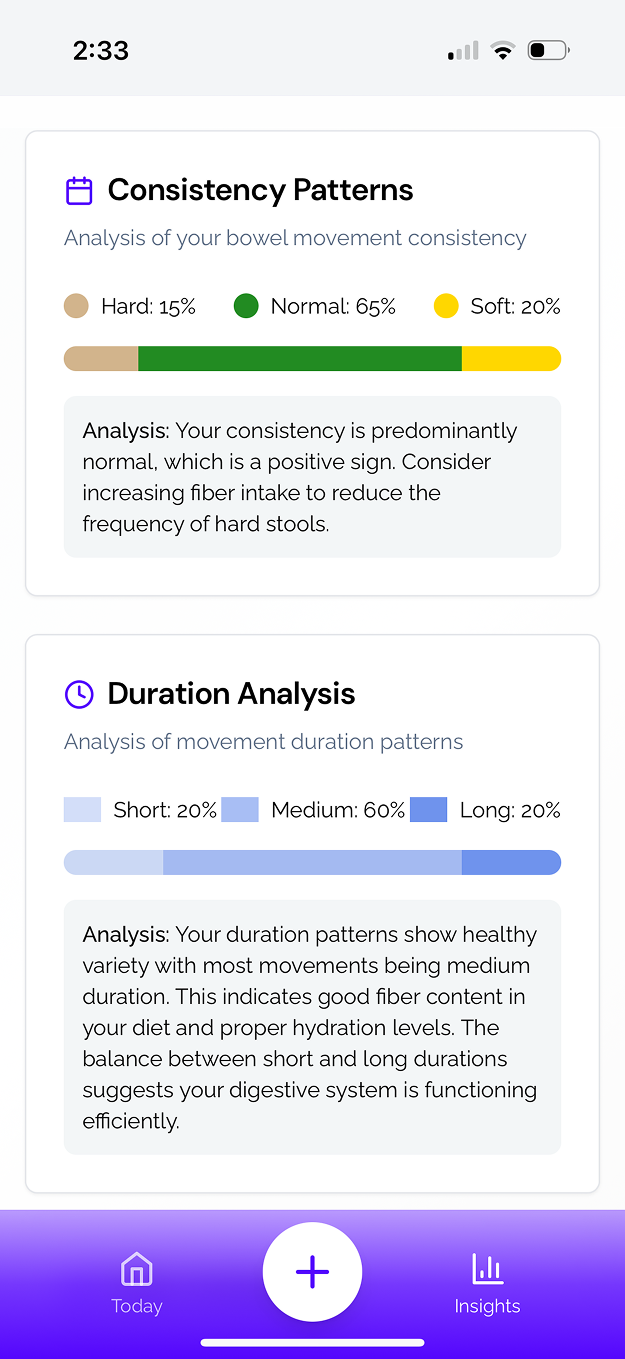
This is exactly why continuous, low-effort tracking is interesting: it establishes your baseline well enough that a genuine change becomes visible. That is the premise behind SNIFR, and our overview of advanced digestive monitoring for IBS and gastrointestinal diseases covers how objective pattern data supports clinical care rather than replacing it. SNIFR does not diagnose any condition and does not replace colonoscopy, endoscopy, breath testing, stool studies, or blood work.
What to Track Alongside Your Bristol Type
- Timing and frequency. How many movements per day, at what times, and how urgent.
- Associated symptoms. Bloating, gas, cramping, straining, incomplete evacuation, and crucially any mucus or blood.
- Food and fluid. The preceding day's meals in broad strokes, plus hydration and alcohol or caffeine intake.
- Stress and sleep. Both in the preceding 24 to 48 hours. Poorer than usual subjective sleep quality predicts next-day abdominal pain and lower gastrointestinal symptoms in IBS (Topan et al., American Journal of Gastroenterology, 2024).
- Cycle phase where relevant. Gastrointestinal symptoms increase during premenstrual and menstrual phases in women with IBS (Heitkemper and Jarrett, Nutrition in Clinical Practice, 2008).
- Medication and supplement changes. These are the most commonly overlooked explanation for a sudden shift.
What the Supplement Literature Actually Studied
Patients frequently ask which supplements shift stool form. Naming what has been tested, and at what dose, is not the same as telling you to take it. Discuss any of these with your clinician or dietitian first, particularly if you take other medicines.
| Agent | Dose and duration studied | Reported result | Safety notes | Source |
|---|---|---|---|---|
| L-glutamine | 5 g three times daily for 8 weeks, adults with post-infectious IBS-D and increased intestinal permeability | Primary endpoint of at least 50-point IBS-SSS reduction reached by 79.6% vs 5.8% on placebo; mean Bristol score 6.5 to 3.9 (p<0.0001); lactulose-mannitol ratio normalised | Studied only in post-infectious IBS-D with documented hyperpermeability; caution in hepatic or renal impairment; long-term high-dose safety not established | Zhou et al., 2019 |
| Psyllium (ispaghula husk) | 10 g per day for 12 weeks, primary care IBS | Greater adequate relief than placebo at one and two months; bran 10 g per day did not differ from placebo | Requires adequate fluid; can transiently increase bloating; introduce gradually and separate from other medicines | Bijkerk et al., 2009 |
| Enteric-coated peppermint oil | Enteric-coated preparations in randomised trials versus placebo | Number needed to treat of 3 to prevent one patient having persistent symptoms | Heartburn and reflux are the common adverse effects; the enteric coating matters; caution with gastro-oesophageal reflux disease and hiatus hernia, and avoid crushing capsules | Alammar et al., 2019; Ford et al., 2008 |
| Bifidobacterium infantis 35624 | 1 x 10^8 CFU per day in capsule for 4 weeks, women with IBS | Superior to placebo for abdominal pain and composite score; global improvement exceeded placebo by more than 20% (p<0.02) | Discuss live biotherapeutics with a clinician if immunocompromised, critically ill, or with a central venous catheter | Whorwell et al., 2006 |
Several agents commonly promoted for stool form, including collagen peptides, zinc carnosine and curcumin, do not have randomised trial evidence in IBS of the kind above. That is not proof they do nothing. It is a reason not to present them as though they have been tested.
Hypothetical scenario. As an illustrative scenario, imagine an adult whose stools shifted from a stable Type 4 to a persistent Type 6 over six weeks, with no dietary change but with a new medication started in the same month. Rather than beginning another elimination diet, the record of the timing prompts a clinician to review the medication and to consider the differential for persistent loose stool, which includes bile acid malabsorption, present in roughly a third of patients labelled with IBS-D (Wedlake et al., Alimentary Pharmacology and Therapeutics, 2009), and pancreatic exocrine insufficiency, tested with fecal elastase-1. The tracking made the change visible. The clinician made the diagnosis.
Red Flag Symptoms That Need Prompt Medical Attention
Some stool changes are not tracking problems. The BSG lists family history of colorectal cancer or inflammatory bowel disease, unexplained weight loss, rectal bleeding not due to haemorrhoids, nocturnal diarrhoea and unexplained iron deficiency anaemia as alarm features requiring urgent colonoscopy or radiological evaluation (Vasant et al., Gut, 2021). Seek prompt medical care for:
- Blood in the stool, or black, tarry stools
- Unintentional weight loss
- Diarrhea that wakes you from sleep
- Unexplained anemia or iron deficiency
- Fever, severe pain, or signs of dehydration with watery stools
- A family history of colorectal cancer, inflammatory bowel disease, or celiac disease
- A persistent change in bowel habit in anyone over 50, or earlier with risk factors
A persistent change in bowel habit is one of the classic reasons to be evaluated, and it is worth taking seriously precisely because it is so easy to normalise.
Using the Scale Well
Keep using it. It is genuinely good at what it does. Just be clear about what that is.
Use it to establish your baseline, to notice change, to describe your symptoms accurately to your clinician, and to give structure to what would otherwise be a vague impression. Do not expect it to explain mechanism, predict tomorrow, or replace evaluation when something is genuinely different.
Observation is where good clinical reasoning starts. It is not where it should stop.
Frequently Asked Questions
What does the Bristol Stool Scale actually measure?
It classifies stool form across seven types, validated against measured transit in 66 volunteers whose whole-gut transit was deliberately altered with senna and loperamide. In a later multicentre study, stool form correlated with whole-gut transit at r = -0.61, and a value below 3 predicted delayed transit with 85 percent sensitivity and 82 percent specificity.
Is Type 5 stool normal?
It depends on your baseline. In a large prospective study, 99 percent of adults reported bowel frequency between three times a week and three times a day, so the normal range is wide. If Type 5 has been your stable pattern for years without symptoms it may simply be your normal. Type 5 appearing suddenly after years of Type 4 is more meaningful.
What causes Type 6 stool every day?
Faster transit from several possible causes. Bile acid malabsorption is common: 32 percent of patients with diarrhoea-predominant IBS had SeHCAT seven-day retention below 10 percent in one systematic review, and 80 percent of those responded to colestyramine. Pancreatic insufficiency, carbohydrate malabsorption, medication effects and inflammation also produce it, so daily Type 6 warrants assessment.
Can the Bristol Stool Scale predict a flare-up before it happens?
No. The scale documents what already happened, so it is descriptive rather than predictive. Some people notice a personal sequence, such as Type 5 preceding Type 6, and that pattern can become informally predictive. The scale itself does not forecast anything, which is why context matters more than the number.
When should a change in stool type be checked by a doctor?
Promptly for rectal bleeding, black tarry stools, unintentional weight loss, nocturnal diarrhoea, unexplained iron deficiency anaemia, or fever with severe pain. These are the British Society of Gastroenterology alarm features. A persistent change in bowel habit, particularly after age 50 or with a family history of colorectal cancer, also warrants evaluation.
What should I track alongside my Bristol type?
Bowel frequency and urgency, associated symptoms such as bloating, cramping or mucus, the preceding day's food and fluid, stress and sleep in the previous 24 to 48 hours, cycle phase where relevant, and any medication changes. Poor subjective sleep quality predicts next-day abdominal pain in IBS, and medication changes are the most commonly overlooked explanation for a sudden shift.
Do any supplements actually change stool form in IBS?
A few have randomised trial evidence. Glutamine at 5 g three times daily for eight weeks reduced mean Bristol score from 6.5 to 3.9 in post-infectious IBS-D with documented hyperpermeability. Psyllium at 10 g per day beat placebo in primary care IBS. These are what the trials studied, not recommendations; discuss any supplement with your clinician first.
References
- Lewis SJ, Heaton KW. Stool Form Scale as a Useful Guide to Intestinal Transit Time. Scandinavian Journal of Gastroenterology. 1997;32(9):920-924. doi:10.3109/00365529709011203
- Saad RJ, Rao SSC, Koch KL, et al. Do Stool Form and Frequency Correlate With Whole-Gut and Colonic Transit? Results From a Multicenter Study in Constipated Individuals and Healthy Controls. American Journal of Gastroenterology. 2010;105(2):403-411. doi:10.1038/ajg.2009.612
- Heaton KW, Radvan J, Cripps H, Mountford RA, Braddon FEM, Hughes AO. Defecation frequency and timing, and stool form in the general population: a prospective study. Gut. 1992;33(6):818-824. doi:10.1136/gut.33.6.818
- Lacy BE, Mearin F, Chang L, Chey WD, Lembo AJ, Simren M, Spiller R. Bowel Disorders. Gastroenterology. 2016;150(6):1393-1407.e5. doi:10.1053/j.gastro.2016.02.031
- van Rheenen PF, Van de Vijver E, Fidler V. Faecal calprotectin for screening of patients with suspected inflammatory bowel disease: diagnostic meta-analysis. BMJ. 2010;341:c3369. doi:10.1136/bmj.c3369
- Wedlake L, A’Hern R, Russell D, Thomas K, Walters JRF, Andreyev HJN. Systematic review: the prevalence of idiopathic bile acid malabsorption as diagnosed by SeHCAT scanning in patients with diarrhoea-predominant irritable bowel syndrome. Alimentary Pharmacology and Therapeutics. 2009;30(7):707-717. doi:10.1111/j.1365-2036.2009.04081.x
- Kelly CR, Fischer M, Allegretti JR, et al. ACG Clinical Guidelines: Prevention, Diagnosis, and Treatment of Clostridioides difficile Infections. American Journal of Gastroenterology. 2021;116(6):1124-1147. doi:10.14309/ajg.0000000000001278
- de la Iglesia D, Agudo-Castillo B, Galego-Fernández M, Rama-Fernández A, Domínguez-Muñoz JE. Diagnostic Accuracy of Fecal Elastase-1 Test for Pancreatic Exocrine Insufficiency: A Systematic Review and Meta-Analysis. United European Gastroenterology Journal. 2025;13(8):1571-1582. doi:10.1002/ueg2.70061
- Zhou Q, Verne ML, Fields JZ, et al. Randomised placebo-controlled trial of dietary glutamine supplements for postinfectious irritable bowel syndrome. Gut. 2019;68(6):996-1002. doi:10.1136/gutjnl-2017-315136
- Bijkerk CJ, de Wit NJ, Muris JWM, Whorwell PJ, Knottnerus JA, Hoes AW. Soluble or insoluble fibre in irritable bowel syndrome in primary care? Randomised placebo controlled trial. BMJ. 2009;339:b3154. doi:10.1136/bmj.b3154
- Alammar N, Wang L, Saberi B, et al. The impact of peppermint oil on the irritable bowel syndrome: a meta-analysis of the pooled clinical data. BMC Complementary and Alternative Medicine. 2019;19(1):21. doi:10.1186/s12906-018-2409-0
- Ford AC, Talley NJ, Spiegel BMR, et al. Effect of fibre, antispasmodics, and peppermint oil in the treatment of irritable bowel syndrome: systematic review and meta-analysis. BMJ. 2008;337:a2313. doi:10.1136/bmj.a2313
- Whorwell PJ, Altringer L, Morel J, et al. Efficacy of an Encapsulated Probiotic Bifidobacterium infantis 35624 in Women with Irritable Bowel Syndrome. American Journal of Gastroenterology. 2006;101(7):1581-1590. doi:10.1111/j.1572-0241.2006.00734.x
- Topan R, Vork L, Fitzke H, et al. Poor Subjective Sleep Quality Predicts Symptoms in Irritable Bowel Syndrome Using the Experience Sampling Method. American Journal of Gastroenterology. 2024;119(1):155-164. doi:10.14309/ajg.0000000000002510
- Heitkemper MM, Jarrett M. Update on Irritable Bowel Syndrome and Gender Differences. Nutrition in Clinical Practice. 2008;23(3):275-283. doi:10.1177/0884533608318672
- Vasant DH, Paine PA, Black CJ, et al. British Society of Gastroenterology guidelines on the management of irritable bowel syndrome. Gut. 2021;70(7):1214-1240. doi:10.1136/gutjnl-2021-324598
- Lacy BE, Pimentel M, Brenner DM, Chey WD, Keefer LA, Long MD, Moshiree B. ACG Clinical Guideline: Management of Irritable Bowel Syndrome. American Journal of Gastroenterology. 2021;116(1):17-44. doi:10.14309/ajg.0000000000001036
- Garsed K, Chernova J, Hastings M, et al. A randomised trial of ondansetron for the treatment of irritable bowel syndrome with diarrhoea. Gut. 2014;63(10):1617-1625. doi:10.1136/gutjnl-2013-305989
- Ong DK, Mitchell SB, Barrett JS, et al. Manipulation of dietary short chain carbohydrates alters the pattern of gas production and genesis of symptoms in irritable bowel syndrome. Journal of Gastroenterology and Hepatology. 2010;25(8):1366-1373. doi:10.1111/j.1440-1746.2010.06370.x
- Vanuytsel T, van Wanrooy S, Vanheel H, et al. Psychological stress and corticotropin-releasing hormone increase intestinal permeability in humans by a mast cell-dependent mechanism. Gut. 2014;63(8):1293-1299. doi:10.1136/gutjnl-2013-305690
- Zmora N, Suez J, Elinav E. You are what you eat: diet, health and the gut microbiota. Nature Reviews Gastroenterology & Hepatology. 2019;16(1):35-56. doi:10.1038/s41575-018-0061-2
SNIFR is designed to provide insights about gut health patterns, not to diagnose or treat medical conditions. Individual results may vary as gut health is influenced by numerous factors including diet, stress, sleep, and genetics. SNIFR is currently in development, and features described may evolve before commercial release.
Other Posts



Be first to try SNIFR. Beta coming soon.
Join our waitlist to get notified when the app launches. Start understanding your gut health sooner.