
Microbiome Tracking: The Advanced Biohacker Protocol
Microbiome tracking is the missing biomarker in your performance stack. Here is the protocol for baselining, correlating with HRV and CGM, and iterating.
In biohacking we have quantified almost everything: heart rate variability, glucose, ketones, sleep stages, even brain waves. Yet for all of that instrumentation, one signal has stayed dark. Real-time gut microbiome data.
Let's talk about the mechanism first, then the protocol. Your gut microbiome is not a passive tenant. It is a metabolically active organ that produces signaling molecules, and those molecules feed forward into nearly every metric already on your dashboard. If you are serious about performance optimization, microbiome tracking is the missing input.
The Gut Microbiome as Mission Control for Performance
Here is what is happening at the cellular level. Your gut bacteria ferment substrate, produce metabolites, and those metabolites act on the nervous system, the immune system, and the endocrine system simultaneously.
- Cognitive function. More than 90 percent of the body's serotonin sits in the gastrointestinal tract, produced by enterochromaffin cells whose output is regulated by indigenous spore-forming bacteria (Yano et al., Cell, 2015). That serotonin pool, plus vagal signaling, shapes focus, mood, and cognitive flexibility.
- Recovery capability. Bacterial metabolites such as butyrate and propionate participate in the inflammatory signaling that shapes how quickly you adapt to a training load.
- Energy production. Microbial enzymes determine how efficiently you extract and use nutrients from the food you already track.
- Hormone regulation. Gut bacteria interact with pathways involved in cortisol signaling and insulin sensitivity, both of which are core biomarkers for any serious self-quantifier.
- Immune function. Gut-associated lymphoid tissue represents close to 70 percent of the entire immune system, and roughly 80 percent of the body's plasma cells reside there (Vighi et al., Clinical and Experimental Immunology, 2008). Bacterial balance shapes how resilient that tissue is.
Despite that central role, most biohackers are running open loop on the microbiome. They rely on periodic stool tests that deliver a static, delayed snapshot of a system that changes daily. Microbial composition oscillates across the day and is entrained largely by feeding time, which is exactly why a quarterly point estimate is the wrong instrument (Thaiss et al., Cell, 2014).
Traditional Gut Testing vs. Advanced Gut Health Monitoring
Compare the two approaches directly. The gap is not small.
Traditional gut testing
- Sampled once every three to six months
- Results delayed by weeks
- Static snapshot of a dynamic system
- No correlation with your other biomarkers
- Limited actionability
Advanced biome tracking
- Continuous, at-home monitoring
- Near real-time data feedback
- Dynamic trend analysis rather than point estimates
- Direct correlation with the rest of your stack
- Intervention windows you can actually act on
| Attribute | Conventional stool sequencing | Continuous biome tracking |
|---|---|---|
| Sampling frequency | Once every 3 to 6 months | Daily, passive |
| Result latency | 2 to 6 weeks | Near real time |
| Data structure | Point estimate | Trend series |
| Captures diurnal variation | No | Yes |
| Correlates with HRV, CGM, sleep | Difficult, timestamps rarely align | Native, same time axis |
| Iteration speed for an n-of-1 test | One data point per quarter | Multiple data points per week |
| Best use | Broad composition context | Protocol iteration and correlation |
The difference is structurally identical to the jump from a single fingerstick glucose reading to continuous glucose monitoring. One gives you a moment. The other gives you the pattern that drives optimization.
The Performance Stack: Integrating Microbiome Data
The value of microbiome tracking compounds when it sits alongside the biomarker infrastructure you already own. Four integration points matter most.
Protocol 1: Morning optimization
Microbial composition and activity oscillate across the day, entrained in part by feeding and light. In mice and humans, both taxa abundance and microbial functional pathways show diurnal rhythmicity that collapses when feeding times are disrupted (Thaiss et al., Cell, 2014). Once you can see your own overnight pattern, you can set your fasting window, time your first meal to support beneficial bacterial growth, and place prebiotic intake when your keystone species are most active.
Protocol 2: Training enhancement
Time pre-workout nutrition against your own bacterial metabolic cycles rather than a generic template. Exercise training independently alters both the composition and the functional capacity of the gut microbiota, with increases in short-chain fatty acid producing taxa reported across human and animal work (Mailing et al., Exercise and Sport Sciences Reviews, 2019). Use tracking to decide whether a supplement is actually shifting anything, and structure post-training meals around the fibers that feed anti-inflammatory species.
Protocol 3: Cognitive performance tuning
The gut brain axis is a large and underused optimization surface, spanning neural, endocrine, immune, and metabolic channels (Cryan et al., Physiological Reviews, 2019). Track which foods precede your best focus blocks, which bacterial patterns line up with peak cognitive states, and which prebiotics support the species associated with neurotransmitter precursor production in your particular gut.
Protocol 4: Sleep architecture engineering
Dinner timing, fiber load, and evening polyphenol intake all interact with microbial rhythms. Correlate those inputs against your deep sleep and REM percentages and you will find your own dose response curve rather than someone else's.
Cross-Biomarker Correlation: Where the Real Signal Lives
Single-metric tracking hides relationships. Cross-biomarker analysis exposes them. The advanced move is to line up microbiome data against the streams you already collect.
- Microbiome and HRV. Look for bacterial shifts that precede changes in autonomic balance.
- Microbiome and CGM. Identify which compositional states line up with your flattest postprandial curves for a given food.
- Microbiome and sleep tracking. Map how gut activity relates to slow wave sleep and REM distribution.
- Microbiome and wearable stress metrics. Watch how diversity tracks against stress resilience over weeks, not days.
The rationale for doing this at the individual level rather than the population level is well established. Person-specific microbiome features drive person-specific responses to the same input, which is why population averages routinely fail to predict what a given individual will do (Zmora et al., Cell Host and Microbe, 2016).
This is the same logic used across the rest of advanced gut health optimization for biohackers: build the correlation matrix first, then intervene on the variable with the strongest relationship to the outcome you care about.
Beyond Probiotics: Precision Interventions
With continuous data, generic gut health advice stops being useful. You move from population averages to precision interventions with a measurable readout.
- Strain-specific probiotics selected against an identified gap rather than a proprietary blend chosen by marketing.
- Personalized prebiotic protocols that supply the specific fiber types your beneficial populations use.
- Circadian-aligned feeding windows timed to your own bacterial rhythms.
- Precision polyphenol intake aimed at the plant compounds associated with your keystone species.
- Sequential testing of emerging approaches such as targeted bacteriophage work, which remains investigational and belongs in the read-the-research column rather than the run-it-tomorrow column.
Implementing Your Advanced Tracking Protocol
- Establish your baseline. Two to four weeks of monitoring before you change anything. No interventions. You cannot detect a signal without a floor.
- Correlate with existing metrics. Pull gut data alongside HRV, sleep, and glucose into one place and look for repeatable relationships.
- Design sequential interventions. One variable at a time. Stacking four changes at once guarantees you learn nothing about any of them.
- Develop personal algorithms. Over months you will accumulate your own triggers, your own beneficial foods, and your own timing rules. That is the actual deliverable.
- Build microbial resilience. The endpoint is not a peak score. It is a diverse, adaptive microbiome that holds up under travel, deadlines, and hard training blocks.
Hypothetical scenario. As an illustrative example, imagine a masters cyclist who has tracked HRV for three years and adds daily gut monitoring. For four weeks he changes nothing. He then moves 60 percent of his fiber intake into breakfast and lunch and holds everything else fixed for six weeks. Because bacterial composition must shift before metabolite output shifts before vagal signaling shifts, any HRV response would be expected on a multi-week lag rather than overnight, which is exactly why the four-week baseline and the single-variable design matter. Whether the effect appears at all is an empirical question his own data answers. This scenario is illustrative only and is not a described outcome.
Key Performance Insights
- Static stool testing samples a dynamic system too infrequently to support iteration. Microbial rhythms are diurnal and feeding-entrained (Thaiss et al., Cell, 2014).
- Microbiome data is most valuable as a correlate, not in isolation. Its job is to explain variance in HRV, sleep, and glucose.
- Sequential single-variable interventions produce interpretable data. Simultaneous changes do not.
- Individual response to the same intervention varies substantially, which is the core argument for n-of-1 tracking over population guidance (Zmora et al., Cell Host and Microbe, 2016).
- Resilience under stress is a better long-term target than any single-day diversity score.
Frequently Asked Questions
What is microbiome tracking and how is it different from a stool test?
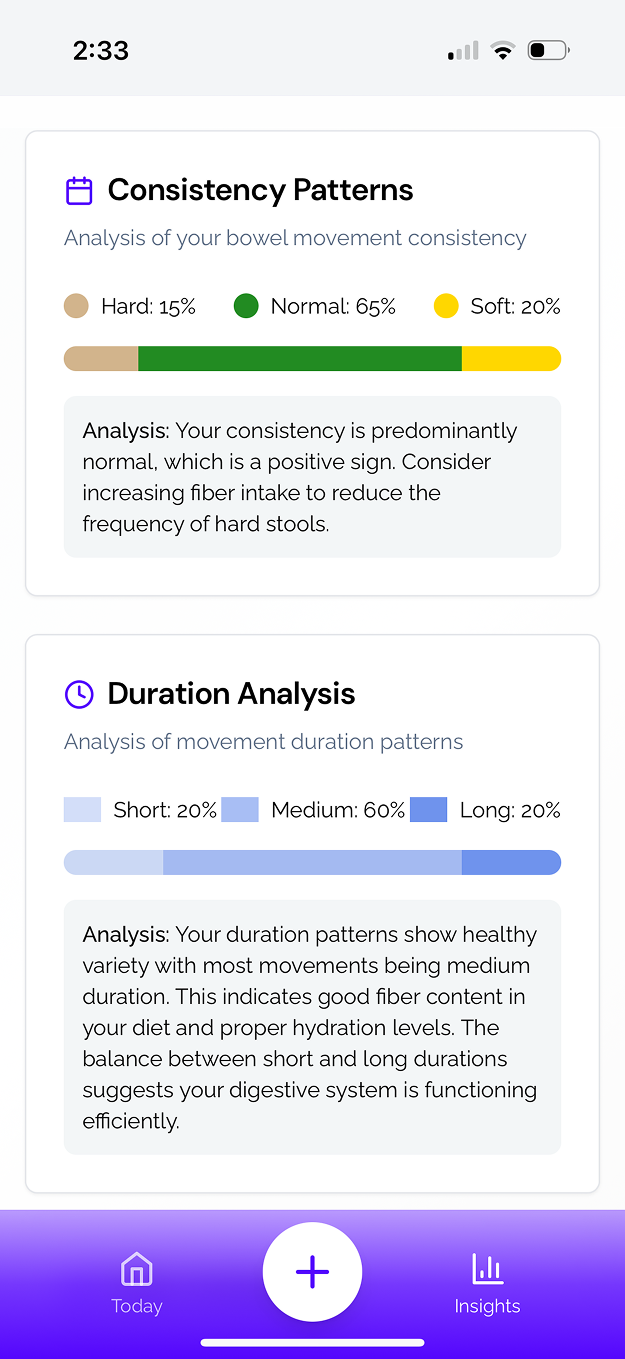
Microbiome tracking is ongoing, at-home monitoring of gut activity rather than a single laboratory snapshot. A conventional stool test samples a dynamic system once every few months and returns results weeks later. Continuous tracking produces trend data you can correlate with HRV, sleep, and glucose, which is what makes an intervention testable rather than assumed.
How do I optimize my gut microbiome for performance?
Start by establishing a baseline before changing anything, then run one intervention at a time. Two to four weeks of unmodified tracking gives you a floor to measure against. From there, adjust a single variable such as fiber type, meal timing, or a specific probiotic strain, and watch the downstream effect on your existing biomarkers before stacking the next change.
Can I correlate gut health data with HRV data?
Yes, and it is one of the more useful pairings in a quantified self stack. Vagal signaling links gut activity to autonomic tone, so bacterial shifts often appear in HRV trends over a period of weeks. Track both simultaneously, compare seven-day rolling averages rather than single readings, and look for repeatable timing between an intervention and an HRV response.
How often should biohackers test their microbiome?
Quarterly lab testing is enough for a broad composition picture, but it is too infrequent for protocol iteration. Passive daily monitoring is what allows you to connect a specific meal, training session, or supplement to a measurable change. The practical answer is continuous tracking for decisions and periodic deeper testing for context.
Do probiotics work for everyone?
No. Response varies substantially with baseline composition, diet, and transit time, which is exactly why tracking matters. A strain that shifts one person's metrics may produce nothing measurable in another. Treat any probiotic as an experiment with a defined start date, a fixed duration, and a specific metric you are watching.
Does exercise itself change the gut microbiome?
Yes. Reviews of the human and animal literature conclude that exercise training independently alters gut microbial composition and functional capacity, generally increasing short-chain fatty acid producing taxa, with effects that appear to depend on training volume and to fade when training stops (Mailing et al., Exercise and Sport Sciences Reviews, 2019). That makes training load a variable you must hold steady while testing a dietary change.
References
- Cryan JF, O'Riordan KJ, Cowan CSM, et al. The Microbiota-Gut-Brain Axis. Physiological Reviews. 2019;99(4):1877-2013. doi:10.1152/physrev.00018.2018
- Thaiss CA, Zeevi D, Levy M, et al. Transkingdom Control of Microbiota Diurnal Oscillations Promotes Metabolic Homeostasis. Cell. 2014;159(3):514-529. doi:10.1016/j.cell.2014.09.048
- Mailing LJ, Allen JM, Buford TW, Fields CJ, Woods JA. Exercise and the Gut Microbiome: A Review of the Evidence, Potential Mechanisms, and Implications for Human Health. Exercise and Sport Sciences Reviews. 2019;47(2):75-85. doi:10.1249/JES.0000000000000183
- Clark A, Mach N. Exercise-induced stress behavior, gut-microbiota-brain axis and diet: a systematic review for athletes. Journal of the International Society of Sports Nutrition. 2016;13:43. doi:10.1186/s12970-016-0155-6
- Zmora N, Zeevi D, Korem T, Segal E, Elinav E. Taking It Personally: Personalized Utilization of the Human Microbiome in Health and Disease. Cell Host and Microbe. 2016;19(1):12-20. doi:10.1016/j.chom.2015.12.016
- Yano JM, Yu K, Donaldson GP, et al. Indigenous Bacteria from the Gut Microbiota Regulate Host Serotonin Biosynthesis. Cell. 2015;161(2):264-276. doi:10.1016/j.cell.2015.02.047
- Vighi G, Marcucci F, Sensi L, Di Cara G, Frati F. Allergy and the gastrointestinal system. Clinical and Experimental Immunology. 2008;153(Suppl 1):3-6. doi:10.1111/j.1365-2249.2008.03713.x
SNIFR is designed to provide insights about gut health patterns, not to diagnose or treat medical conditions. Individual results may vary as gut health is influenced by numerous factors including diet, stress, sleep, and genetics. SNIFR is currently in development, and features described may evolve before commercial release.
Other Posts
Be first to try SNIFR. Beta coming soon.
Join our waitlist to get notified when the app launches. Start understanding your gut health sooner.