
Advanced IBS Monitoring: How Clinical Care Is Changing
What is actually FDA cleared in GI artificial intelligence, what the economic and quality of life data show, and what advanced IBS monitoring changes in the consultation.

Your gastroenterologist has a short appointment with you, perhaps twice a year. In that time you are expected to summarise months of variable symptoms, and they are expected to adjust your plan based on that summary. Both of you are doing your best with a thin slice of information.
That constraint has shaped IBS care for a long time. It is also the constraint most likely to change, because continuous measurement is arriving across medicine and gastroenterology is not exempt.
What follows is a clinician's read on what is genuinely changing, what is still aspirational, and what any of it means for someone managing IBS today.
Why This Is Happening Now
Several developments have converged, and no single one of them would be enough on its own.
Sensors Got Small
Analytical capability that once required laboratory instrumentation is being miniaturised. That makes repeated, at-home measurement plausible in a way it simply was not twenty years ago. The volatile organic compound literature illustrates the shift: work that began with gas chromatography and mass spectrometry in research laboratories now includes field asymmetric ion mobility spectrometry and electronic nose platforms (van Gaal et al., Journal of Breath Research, 2018; de Meij et al., International Journal of Cancer, 2014).
Pattern Analysis Got Better, in Specific Places
Machine learning is well suited to finding structure in noisy, multi-variable data. It is important to be exact about where that has actually paid off in gastroenterology. The mature, regulated application is image analysis during endoscopy.
| What is authorised | Regulatory status | Evidence | What it does not cover |
|---|---|---|---|
| GI Genius computer-aided polyp detection | FDA De Novo, April 2021; the first AI device authorised for colonoscopy | In a randomised trial of 685 subjects, adenoma detection rate 54.8% with CADe versus 40.4% without, RR 1.30 (Repici et al., 2020) | Does not diagnose, predict symptoms, or work outside colonoscopy |
| EndoScreener computer-aided polyp detection | FDA 510(k), November 2021 | Cleared using GI Genius as predicate | As above |
| SKOUT computer-aided polyp detection | FDA 510(k), September 2022 | Cleared using GI Genius as predicate | As above |
| At-home VOC monitoring of gut gas | Not FDA cleared or authorised for any diagnostic or predictive claim | Research-grade: pooled sensitivity 87% and specificity 83% for IBD across 696 cases and 605 controls (Krishnamoorthy et al., 2024); 57% of IBS studies separated cases from controls with AUC 0.83-0.99 (Zhang et al., 2023) | Not a diagnostic, not a screening test, not a predictor of IBS flares |
So the accurate statement is that the FDA has authorised multiple AI-based computer-aided detection systems for identifying polyps during colonoscopy, and has not authorised any AI system that predicts IBS flares, diagnoses IBS, or interprets at-home gut chemistry. Those are different claims.
Microbiome Science Matured, Without Producing a Test
We understand far more than we did about how gut bacteria influence motility, barrier function, immune signalling, and symptom generation. But the most careful synthesis of case-control studies concluded that although the microbiota of patients with IBS differs from controls, no consistent bacterial signature emerged across studies (Pittayanon et al., Gastroenterology, 2019). Knowledge has advanced. A microbiome test that guides IBS treatment has not arrived.
Objective Signals Are Being Tested Prospectively
The most interesting recent work in this space is in inflammatory bowel disease rather than IBS. In 309 participants across 36 states, wearable-derived heart rate variability, heart rate, resting heart rate, steps and oxygenation were significantly altered up to seven weeks before both inflammatory and symptomatic flares (Hirten et al., Gastroenterology, 2025). That is a research finding rather than a cleared capability, but it is the shape of the thing that is coming.
Patients Expect Participation, and Remote Care Became Normal
People increasingly expect to see their own health data and to be part of the decisions made from it. Telehealth is now routine infrastructure rather than a novelty, which makes continuous data more useful, since there is somewhere for it to go between visits.
What Actually Changes in the Consultation
The most immediate effect is not technological, it is conversational. When you arrive with a structured record instead of an impression, the appointment starts from shared information rather than from reconstruction. The evidence that reconstruction is unreliable is strong: in one photosensor-verified study, only 11 percent of participants completed paper diaries as instructed while 90 percent reported that they had (Stone et al., BMJ, 2002).
Structured data also makes routine clinical tasks easier. Rome IV subtyping depends on predominant stool form on days with abnormal bowel movements (Lacy et al., Gastroenterology, 2016), and treatment response is best judged against a validated instrument such as the IBS-SSS, where a 50-point change is treated as clinically meaningful (Francis et al., Alimentary Pharmacology and Therapeutics, 1997).
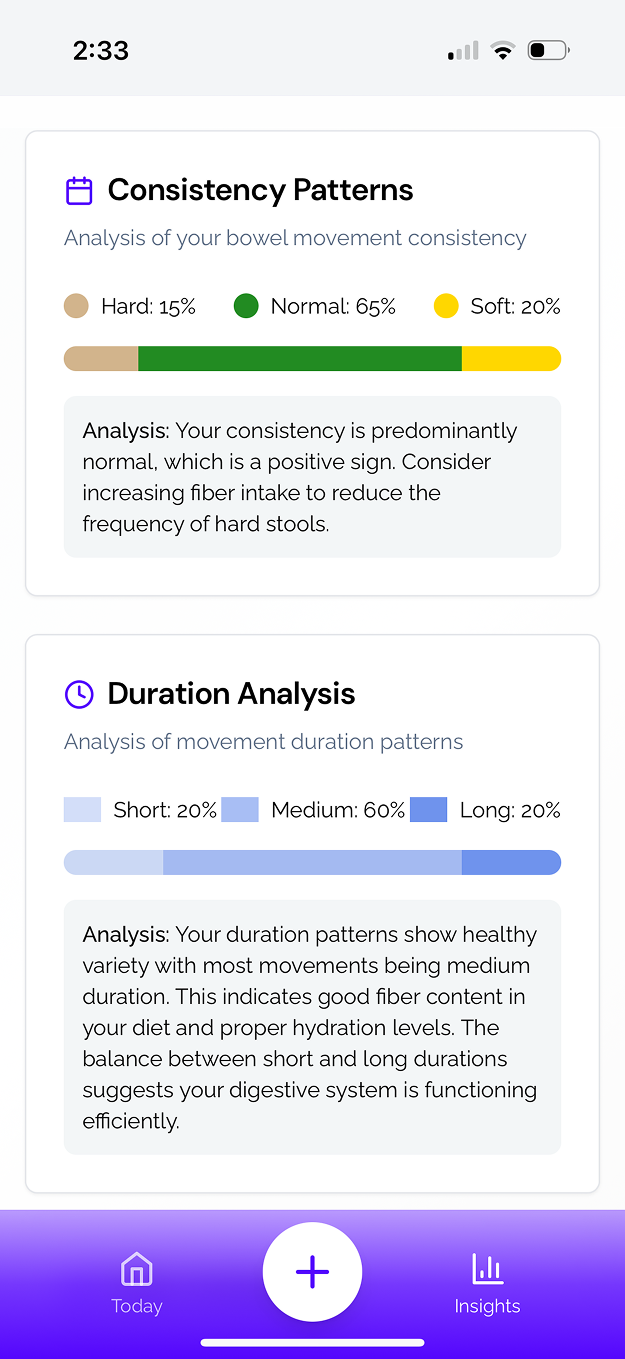
It does not change who does what. Your clinician still holds diagnostic responsibility, still decides what testing is warranted, still prescribes, and still recognises the patterns that need investigation. SNIFR and tools like it are designed to feed that process, not to perform it. Our overview of advanced digestive monitoring for IBS and gastrointestinal diseases sets out the division of labour in more detail.
The Cost Argument, Stated Honestly
IBS carries a substantial economic burden. In a retrospective analysis of a US commercially insured population, mean annual all-cause healthcare costs for patients with IBS-D were 13,038 dollars, of which 58.4 percent was attributable to office visits and other outpatient services (Buono et al., Journal of Managed Care and Specialty Pharmacy, 2017). A parallel analysis in IBS with constipation found mean annual all-cause costs of 11,182 dollars, with 53.7 percent from outpatient services (Doshi et al., Journal of Managed Care Pharmacy, 2014). Quality of life impairment is comparable to or worse than several chronic organic diseases (Gralnek et al., Gastroenterology, 2000).
A meaningful share of that spending goes into approaches that do not end up helping the individual patient. Repeated elimination diets, sequential medication trials, and repeat visits for the same unresolved question all cost money and time.
It is reasonable to expect that better information reduces some of that waste. It is not reasonable, at this stage, to attach specific savings percentages to it. Health economic claims require health economic studies, and the ones that would justify precise figures for at-home digestive monitoring have not been published.
Enhancement, Not Replacement
This point matters enough to state without hedging. Advanced monitoring does not replace clinical care, and no responsible version of this technology tries to.
It does not diagnose IBS, inflammatory bowel disease, celiac disease, SIBO, or colorectal cancer. It does not replace colonoscopy, endoscopy, breath testing, stool studies, or blood work. It does not determine your medication. And it is not a reason to delay evaluation of a symptom that concerns you.
The tests it does not replace have real, published performance. Fecal calprotectin has pooled sensitivity of 93 percent and specificity of 94 percent for inflammatory bowel disease in adults (van Rheenen et al., BMJ, 2010). Hydrogen and methane breath testing has consensus thresholds of a hydrogen rise of at least 20 parts per million by 90 minutes and methane of at least 10 parts per million (Rezaie et al., American Journal of Gastroenterology, 2017). IgA anti-tissue transglutaminase has reported sensitivity of 90.7 percent and specificity of 87.4 percent in adults (Sheppard et al., Alimentary Pharmacology and Therapeutics, 2022). That is the standard.
What monitoring can do is give a clinician better raw material. In a specialty where so much depends on the accuracy of a patient's account, better raw material is worth having.
Hypothetical scenario. As an illustrative scenario, imagine a fifteen-minute follow-up in which a patient brings twelve weeks of stool form records and three monthly IBS-SSS scores. Rather than spending most of the appointment reconstructing the period, the clinician sees a 55-point improvement that crosses the threshold treated as clinically meaningful (Francis et al., Alimentary Pharmacology and Therapeutics, 1997) and spends the time on the reintroduction plan instead. Nothing was diagnosed by a device, and no medication decision was made by an algorithm. The gain was in what the consultation could cover.
Reasonable Skepticism, Reasonably Answered
- Will this be complicated? Passive monitoring is designed specifically so the answer is no. If a system requires the same effort as a diary, it has solved nothing, and the diary compliance data explain why.
- Will it make me more anxious? For many patients, uncertainty is the larger stressor and information reduces it. For some, closer monitoring increases preoccupation. Psychological state measurably influences symptom perception and reporting in IBS (Enck et al., Nature Reviews Disease Primers, 2016), so this is worth discussing rather than assuming.
- What if my clinician is not interested? Many are receptive to structured patient-generated data even without prior experience of it. Bring patterns and questions rather than conclusions.
- What if the data contradicts what I believed? That is often the most useful outcome. Confidently held trigger beliefs are frequently the source of unnecessary restriction.
- Is it validated? Not yet, in the sense a clinician means by that word. This is emerging technology in a wellness category, and it should be evaluated as such.
Red Flag Symptoms That Need Prompt Medical Attention
Whatever the state of the technology, these override it. The BSG lists family history of colorectal cancer or inflammatory bowel disease, unexplained weight loss, rectal bleeding not due to haemorrhoids, nocturnal diarrhoea and unexplained iron deficiency anaemia as alarm features requiring urgent colonoscopy or radiological evaluation of the colon (Vasant et al., Gut, 2021). Seek prompt medical care for:
- Rectal bleeding, or black, tarry stools
- Unintentional weight loss
- Diarrhea or pain that wakes you from sleep
- Unexplained anemia or iron deficiency
- Fever, persistent vomiting, or severe abdominal pain
- A family history of colorectal cancer, inflammatory bowel disease, or celiac disease
- New or changing bowel symptoms after age 50
And please stay current with colorectal cancer screening. Nothing described in this article is a substitute for it, and the AI systems that do assist with screening operate inside the colonoscopy suite, not at home.
The Wider Pattern
What is happening in digestive health is part of a broader movement from episodic snapshots toward continuous measurement. Continuous glucose monitoring changed diabetes care. Wearable cardiac monitoring changed arrhythmia detection. Sleep tracking changed sleep medicine.
Each of those took years of validation before clinicians relied on them, and each still sits inside a clinical relationship rather than replacing one. Digestive monitoring is earlier on that path. The direction is promising, the destination is not yet reached, and the honest way to describe the present moment is that the tools are becoming interesting rather than that the revolution is complete.
For patients, the practical takeaway is unglamorous and useful: better information makes you a better partner in your own care. Bring it to the appointment. Let your gastroenterologist do the rest.
Frequently Asked Questions
Is advanced monitoring changing how doctors manage IBS?
It is beginning to change the consultation more than the diagnosis. When a patient arrives with structured records rather than a recollection, the appointment starts from shared information. Rome IV subtyping depends on stool form, and treatment response is best judged against a validated instrument such as the IBS-SSS. Diagnostic responsibility and prescribing remain with the clinician.
Does at-home monitoring replace visits to a gastroenterologist?
No. Monitoring does not diagnose IBS, inflammatory bowel disease, celiac disease, SIBO, or cancer, and it does not replace colonoscopy, endoscopy, breath testing, stool studies, or blood work. Those tests have real published performance, such as fecal calprotectin at 93 percent sensitivity and 94 percent specificity for IBD in adults.
Has the FDA approved AI for gastroenterology?
Yes, for computer-aided detection of colorectal polyps during colonoscopy. GI Genius received De Novo authorisation in April 2021, followed by EndoScreener in November 2021 and SKOUT in September 2022. No FDA-authorised device predicts IBS flares, diagnoses IBS, or interprets at-home gut chemistry, which is a different claim entirely.
What is precision gastroenterology?
An approach that tailors digestive care to the individual using continuous, objective data rather than population averages alone. In IBS the concept is appealing because the condition is heterogeneous and no microbiome test yet guides treatment. The tools that would deliver it fully are still in development and validation rather than routine practice.
Is at-home digestive monitoring clinically validated?
Not in the sense clinicians mean. Current at-home VOC monitoring sits in the wellness category. The underlying research is promising, with pooled sensitivity of 87 percent and specificity of 83 percent for inflammatory bowel disease across 696 cases and 605 controls, but those are group-level research findings from small studies, not cleared test characteristics.
Will monitoring reduce what I spend on IBS care?
Possibly, though nobody can responsibly quantify it yet. Mean annual all-cause healthcare costs were 13,038 dollars for IBS-D and 11,182 dollars for IBS-C in US commercially insured populations, much of it outpatient. Better information plausibly reduces waste, but specific savings percentages require health economic studies that have not been published.
How should I bring monitoring data to my doctor?
Bring patterns and questions rather than conclusions. A summary of what tends to precede your flares, how stool form has trended, and what changed when you tried something is far more useful than raw output. A validated score such as the IBS-SSS gives your clinician a comparable number across visits.
References
- Repici A, Badalamenti M, Maselli R, et al. Efficacy of Real-Time Computer-Aided Detection of Colorectal Neoplasia in a Randomized Trial. Gastroenterology. 2020;159(2):512-520.e7. doi:10.1053/j.gastro.2020.04.062
- Krishnamoorthy A, Chandrapalan S, Ahmed M, Arasaradnam RP. The Diagnostic Utility of Volatile Organic Compounds in Inflammatory Bowel Disease: A Systematic Review and Meta-Analysis. Journal of Crohn’s and Colitis. 2024;18(2):320-330. doi:10.1093/ecco-jcc/jjad132
- Zhang VR, Ramachandran GK, Loo EXL, Soh AYS, Yong WP, Siah KTH. Volatile organic compounds as potential biomarkers of irritable bowel syndrome: A systematic review. Neurogastroenterology & Motility. 2023;35(7):e14536. doi:10.1111/nmo.14536
- van Gaal N, Lakenman R, Covington J, et al. Faecal volatile organic compounds analysis using field asymmetric ion mobility spectrometry: non-invasive diagnostics in gastrointestinal disease. Journal of Breath Research. 2018;12(1):016006. doi:10.1088/1752-7163/aa6f1d
- de Meij TG, Larbi IB, van der Schee MP, et al. Electronic nose can discriminate colorectal carcinoma and advanced adenomas by fecal volatile biomarker analysis: proof of principle study. International Journal of Cancer. 2014;134(5):1132-1138. doi:10.1002/ijc.28446
- Pittayanon R, Lau JT, Yuan Y, et al. Gut Microbiota in Patients With Irritable Bowel Syndrome. A Systematic Review. Gastroenterology. 2019;157(1):97-108. doi:10.1053/j.gastro.2019.03.049
- Hirten RP, Danieletto M, Sanchez-Mayor M, et al. Physiological Data Collected From Wearable Devices Identify and Predict Inflammatory Bowel Disease Flares. Gastroenterology. 2025;168(5):939-951.e5. doi:10.1053/j.gastro.2024.12.024
- Stone AA, Shiffman S, Schwartz JE, Broderick JE, Hufford MR. Patient non-compliance with paper diaries. BMJ. 2002;324(7347):1193-1194. doi:10.1136/bmj.324.7347.1193
- Lacy BE, Mearin F, Chang L, Chey WD, Lembo AJ, Simren M, Spiller R. Bowel Disorders. Gastroenterology. 2016;150(6):1393-1407.e5. doi:10.1053/j.gastro.2016.02.031
- Francis CY, Morris J, Whorwell PJ. The irritable bowel severity scoring system: a simple method of monitoring irritable bowel syndrome and its progress. Alimentary Pharmacology and Therapeutics. 1997;11(2):395-402. doi:10.1046/j.1365-2036.1997.142318000.x
- Buono JL, Mathur K, Averitt AJ, Andrae DA. Economic Burden of Irritable Bowel Syndrome with Diarrhea: Retrospective Analysis of a U.S. Commercially Insured Population. Journal of Managed Care & Specialty Pharmacy. 2017;23(4):453-460. doi:10.18553/jmcp.2016.16138
- Gralnek IM, Hays RD, Kilbourne A, Naliboff B, Mayer EA. The impact of irritable bowel syndrome on health-related quality of life. Gastroenterology. 2000;119(3):654-660. doi:10.1053/gast.2000.16484
- van Rheenen PF, Van de Vijver E, Fidler V. Faecal calprotectin for screening of patients with suspected inflammatory bowel disease: diagnostic meta-analysis. BMJ. 2010;341:c3369. doi:10.1136/bmj.c3369
- Rezaie A, Buresi M, Lembo A, et al. Hydrogen and Methane-Based Breath Testing in Gastrointestinal Disorders: The North American Consensus. American Journal of Gastroenterology. 2017;112(5):775-784. doi:10.1038/ajg.2017.46
- Sheppard AL, Elwenspoek MMC, Scott LJ, et al. Systematic review with meta-analysis: the accuracy of serological tests to support the diagnosis of coeliac disease. Alimentary Pharmacology and Therapeutics. 2022;55(5):514-527. doi:10.1111/apt.16729
- Vasant DH, Paine PA, Black CJ, et al. British Society of Gastroenterology guidelines on the management of irritable bowel syndrome. Gut. 2021;70(7):1214-1240. doi:10.1136/gutjnl-2021-324598
- Lacy BE, Pimentel M, Brenner DM, Chey WD, Keefer LA, Long MD, Moshiree B. ACG Clinical Guideline: Management of Irritable Bowel Syndrome. American Journal of Gastroenterology. 2021;116(1):17-44. doi:10.14309/ajg.0000000000001036
- Chey WD, Kurlander J, Eswaran S. Irritable Bowel Syndrome: A Clinical Review. JAMA. 2015;313(9):949-958. doi:10.1001/jama.2015.0954
- Ford AC, Lacy BE, Talley NJ. Irritable Bowel Syndrome. New England Journal of Medicine. 2017;376(26):2566-2578. doi:10.1056/NEJMra1607547
- Camilleri M. Diagnosis and Treatment of Irritable Bowel Syndrome: A Review. JAMA. 2021;325(9):865-877. doi:10.1001/jama.2020.22532
- Drossman DA, Hasler WL. Rome IV. Functional GI Disorders: Disorders of Gut-Brain Interaction. Gastroenterology. 2016;150(6):1257-1261. doi:10.1053/j.gastro.2016.03.035
- Simrén M, Tack J. New treatments and therapeutic targets for IBS and other functional bowel disorders. Nature Reviews Gastroenterology & Hepatology. 2018;15(10):589-605. doi:10.1038/s41575-018-0034-5
- Doshi JA, Cai Q, Buono JL, et al. Economic Burden of Irritable Bowel Syndrome with Constipation: A Retrospective Analysis of Health Care Costs in a Commercially Insured Population. Journal of Managed Care Pharmacy. 2014;20(4):382-390. doi:10.18553/jmcp.2014.20.4.382
SNIFR is designed to provide insights about gut health patterns, not to diagnose or treat medical conditions. Individual results may vary as gut health is influenced by numerous factors including diet, stress, sleep, and genetics. SNIFR is currently in development, and features described may evolve before commercial release.
Other Posts



Be first to try SNIFR. Beta coming soon.
Join our waitlist to get notified when the app launches. Start understanding your gut health sooner.